A crypto subledger is a specialized accounting subsystem that collects transaction data from blockchains, exchanges, and custodians, then pushes structured journal entries (JEs) into the general ledger (GL). A digital asset subledger automates the 4 stages of crypto accounting — data collection, reconciliation, cost basis calculation, and GL export — replacing manual CSV exports and spreadsheet-based workflows for finance teams at organizations holding Bitcoin (BTC), Ethereum (ETH), or other digital assets.
Data Collection
Ingest from blockchains, exchanges, and custodians via API and on-chain indexing
Reconciliation
Match, deduplicate, and validate transactions across all sources
Cost Basis
Fair value pricing at event time with FIFO, LIFO, HIFO, and Specific ID
GL Export
Generate double-entry journal entries for QuickBooks, Xero, or NetSuite
How Does a Crypto Subledger Work?
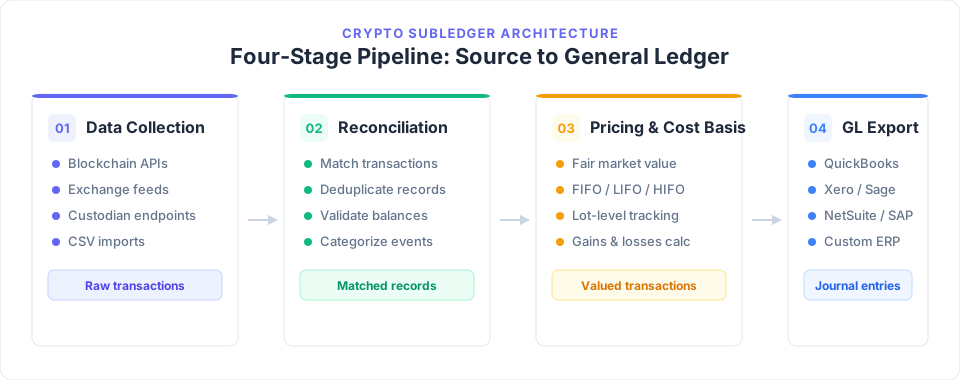
A crypto subledger operates as a four-stage pipeline that transforms raw blockchain and exchange data into audit-ready journal entries for the general ledger.
Data Collection
The crypto subledger ingests transactions from blockchains, exchanges, and custodians through API connections and on-chain indexing.
Reconciliation
The reconciliation engine matches, deduplicates, and validates transactions across sources to produce a single source of truth.
Pricing and Cost Basis
The pricing module applies fair market value at event time and cost basis methods (FIFO, LIFO, HIFO, Specific ID) to every disposal event.
Journal Entry Export
The export layer generates double-entry journal entries and pushes them into accounting software such as QuickBooks, Xero, or NetSuite.
Each stage transforms raw data into progressively more structured accounting information. The crypto subledger processes every transaction through all four stages before posting to the GL.
What Does the Data Collection Layer Handle?
The data collection layer normalizes data from heterogeneous sources into a common transaction format. The ingestion layer connects to 4 categories of data sources outlined below.
- Blockchain node and indexer APIs — Direct on-chain data for Bitcoin, Ethereum, Solana, and 30+ additional networks
- Exchange REST and WebSocket feeds — Real-time trade, deposit, and withdrawal data from centralized exchanges
- Custodian reporting endpoints — Transaction and balance data from institutional custodians such as Fireblocks, BitGo, and Copper
- Manual CSV and file imports — Legacy data from platforms without API access
The data collection layer handles chain-specific nuances such as internal transactions on Ethereum, UTXO-based accounting on Bitcoin, and token standard differences across EVM-compatible networks.
How Does the Processing Engine Transform Transactions?
The processing engine transforms raw transactions into accounting-ready records through 4 operations listed below.
- Transaction categorization and tagging — Rule-based classification of trades, transfers, income, expenses, and DeFi events
- Transfer matching and deduplication — Identification and linking of the same transaction across multiple data sources
- Fair market value pricing at event time — Price lookups from aggregated exchange data at the exact timestamp of each transaction
- Cost basis lot tracking and disposal matching — Lot-level tracking with support for FIFO, LIFO, HIFO, and Specific Identification methods
Processing rules are configurable per entity, supporting multi-entity organizations with different accounting policies.
How Does the GL Export Layer Post Journal Entries?
The GL export layer maps crypto subledger records to the chart of accounts and pushes journal entries into accounting software. The export layer supports 3 categories of GL integrations outlined below.
- SMB accounting software — QuickBooks, Xero, and Sage integration via native API connectors
- Enterprise ERP systems — NetSuite, SAP, and Oracle ERP connectors with configurable field mapping
- Custom GL workflows — Custom GL mapping, multi-level approval flows, and period-end summary or real-time posting
The GL export layer also generates financial reports directly from the crypto subledger for faster close cycles.
How Does a Crypto Subledger Differ from the General Ledger?
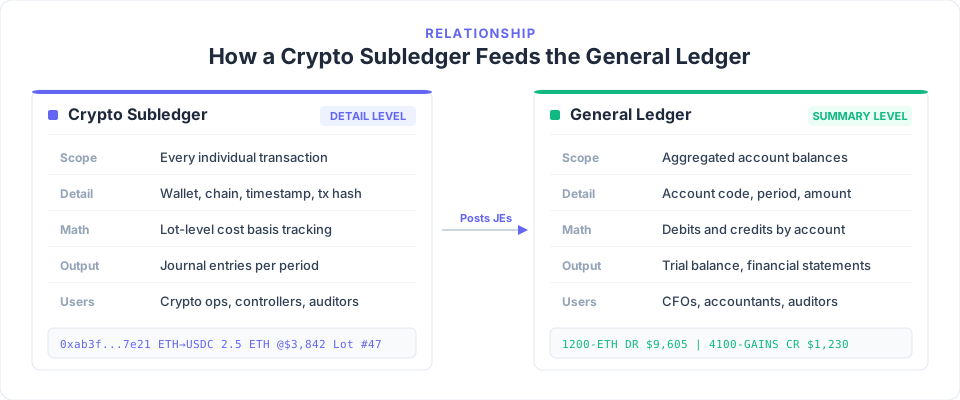
A crypto subledger holds granular transaction-level detail, while the general ledger records aggregated summary totals. The crypto subledger feeds the general ledger through journal entries. The 5 key differences between a crypto subledger and the general ledger are listed below.
The crypto subledger posts journal entries to the GL through periodic or real-time push. Auditors drill from GL totals down to crypto subledger transaction detail to verify accuracy. GL totals match crypto subledger sums when reconciliation is complete.
Who Needs a Crypto Subledger?
Five categories of organizations benefit from a crypto subledger: crypto-native companies, traditional finance firms, corporates, accounting firms, and small teams with growing transaction volume.
Crypto-Native Companies
Exchanges, trading firms, DeFi protocols, DAOs, mining operations, staking operators, and Web3 treasuries generate high transaction volumes across multiple chains. A crypto subledger handles the scale and complexity of crypto-native operations.
Traditional Finance Firms
Hedge funds with crypto exposure, family offices holding BTC and ETH, banks offering custody, and asset managers require audit-grade accounting. The crypto subledger provides the audit trail depth and compliance documentation that institutional investors demand.
Corporates
Corporates holding treasury reserves in crypto, accepting crypto payments, paying payroll in stablecoins, or settling cross-border transactions require ERP integration. The crypto subledger connects digital asset activity to existing NetSuite, SAP, or Oracle workflows.
Accounting Firms
CPA firms serving crypto clients, audit practices, tax advisory teams, and outsourced controllers use a crypto subledger to scale across multiple clients without proportional headcount increases.
Small Teams
Startups with token treasuries, solo finance operators, growing portfolios processing more than 50 transactions per month, and teams preparing for their first audit benefit from a crypto subledger before manual processes break down.
What Is the ROI of a Crypto Subledger?
A crypto subledger reduces manual accounting labor by 60–80%, eliminates reconciliation errors, and accelerates the financial close cycle by 5–10 business days. Organizations recover the cost of a crypto subledger within the first quarter of deployment based on labor savings alone.
The 4 primary ROI drivers of a crypto subledger are listed below.
- Time Savings — Automated data collection and categorization eliminates 15–30 hours of manual CSV wrangling every close cycle. Research from the Association of International Certified Professional Accountants (AICPA) published in 2024 found that organizations with automated subledger systems close their books 47% faster than organizations using manual processes.
- Error Reduction — Systematic reconciliation catches discrepancies that spreadsheet workflows miss. A crypto subledger prevents costly restatements. The average financial restatement costs $2.1 million in direct expenses according to a 2023 Audit Analytics study of 4,700 SEC filings.
- Audit Readiness — Complete transaction trails with on-chain provenance satisfy auditor requirements without ad-hoc evidence gathering. The crypto subledger stores every data point from source to journal entry.
- Scalability — A crypto subledger handles ingestion of new wallets, chains, and entities without proportional headcount increases. An organization processing 10,000 transactions per month requires the same subledger configuration as one processing 1,000.
A 2024 Deloitte survey of 300 corporate finance leaders found that 73% of respondents cited transaction volume and data fragmentation as the primary barriers to accurate crypto accounting. Time savings and error reduction from a crypto subledger directly address both barriers.
How Does a Crypto Subledger Connect to Accounting Software?
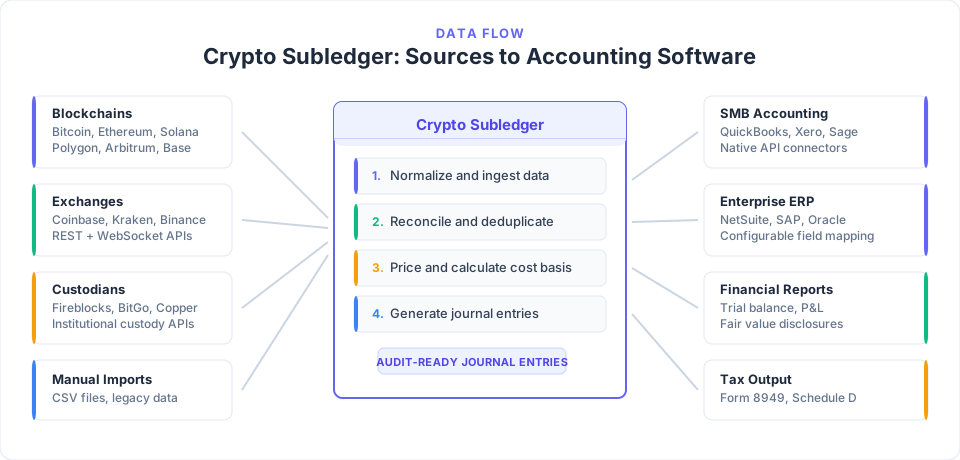
The crypto subledger acts as the translation layer between on-chain data and the general ledger. Journal entries map blockchain events to the chart of accounts in accounting software such as QuickBooks, Xero, or NetSuite. The crypto subledger supports both real-time posting and period-end batch export depending on organizational preference.
What Makes a Good Crypto Subledger?
The right crypto subledger balances breadth of data source coverage, depth of accounting logic, and strength of security controls. There are 5 evaluation criteria for selecting a crypto subledger outlined below.
- Source Coverage — The crypto subledger supports the blockchains, exchanges, and custodians an organization uses today and plans to use in the future.
- Accounting Precision — The crypto subledger implements multiple cost basis methods, handles complex DeFi events correctly, and produces journal entries that reconcile to the penny. Coincile’s tax lot management automates lot-level tracking across all connected wallets and exchanges with FIFO, LIFO, HIFO, and Specific Identification support.
- GL Integration — Native connectors to accounting software provide configurable GL mapping, approval workflows, and period-end controls.
- Security and Privacy — Read-only API access, encrypted data storage, role-based permissions, and SOC 2 compliance protect sensitive financial data.
- Compliance Support — The crypto subledger aligns with FASB ASU 2023-08 and supports the audit trail depth that regulatory compliance frameworks require.
Source coverage and accounting precision are the 2 evaluation criteria that differentiate crypto subledger platforms. A crypto subledger lacking native support for a blockchain or exchange forces manual data entry, negating the automation benefit.
How Does FASB ASU 2023-08 Affect Crypto Subledger Requirements?
FASB ASU 2023-08, issued by the Financial Accounting Standards Board (FASB) in December 2023, requires entities to measure crypto assets at fair value with changes recognized in net income each reporting period. The standard eliminates the previous impairment-only model under which organizations wrote down crypto holdings but never wrote them up. A crypto subledger satisfies FASB ASU 2023-08 requirements by tracking fair market value at every reporting date, calculating unrealized gains and losses automatically, and generating the required fair value disclosures.
Organizations operating under both US GAAP and IFRS use a multi-book crypto subledger to maintain parallel accounting treatments for the same underlying transactions across jurisdictions.
How Does a Crypto Subledger Differ from Tax Software?
Tax software calculates capital gains for filing returns. A crypto subledger handles the entire accounting lifecycle: ingestion, reconciliation, journal entry generation, and GL integration. Tax output is one product of the crypto subledger, not its sole purpose. The 5 key differences between a crypto subledger and tax software are listed below.
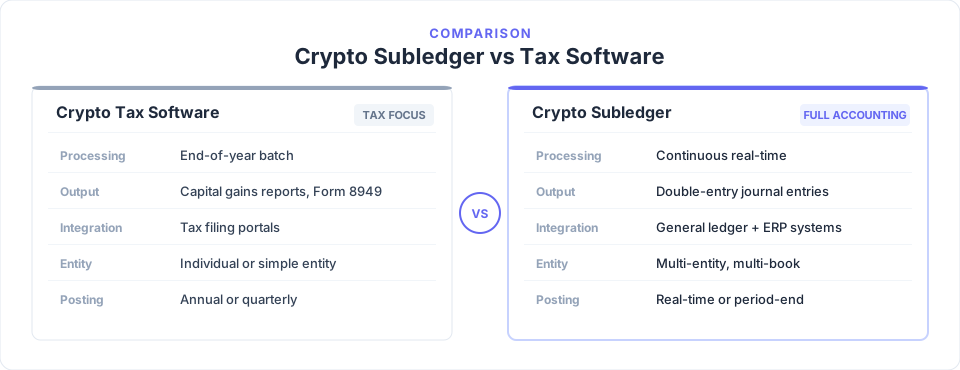
The primary distinction is processing frequency: tax software operates on a batch cycle for filing deadlines, while a crypto subledger processes transactions continuously and posts journal entries to the GL in real time or at period end.
What Are the Core Topics Within Crypto Subledger Accounting?
The crypto subledger domain spans 4 specialized topics listed below.
- Cost Basis Methods — FIFO, LIFO, HIFO, and Specific Identification explained
- Chart of Accounts Setup — Design a chart of accounts for digital assets
- Transaction Categorization — Classify trades, transfers, income, and DeFi events
- Reconciliation Guide — Match on-chain, exchange, and custodian records
These 4 guides cover each stage of the crypto subledger pipeline in detail, from cost basis lot assignment through GL reconciliation. The crypto subledger also intersects with 2 related accounting domains listed below.
- Accounting Standards — FASB ASU 2023-08, IFRS, and digital asset measurement rules
- DeFi Accounting — Liquidity pools, yield farming, and protocol-level accounting
Both domains extend the crypto subledger’s accounting logic into specialized regulatory and transactional contexts.